
M@
In 1965 Moore's law stated that the number of transistors on an integrated circuit for minimum component cost doubles every 24 months.
This fascinating prophecy has been thoroughly self-fulfilled by Moore who is the co-founder of Intel. Another interesting law is Rock's Law. It says that the cost of a semiconductor chip fabrication plant doubles every four years. As of 2003, the price had already reached about 3 billion US dollars. Both laws are compatible with each other as long as the ultimate limit to growth of the industry isn't reached. This limit represents the maximum amount of capital that can be invested in new products. As long as we still love processing, at some point, Rock's Law will collide with Moore's Law. But nobody knows when is this collision going to happen?
Let's refresh our bulbo-memories by having a look at the evolution of the semiconductor industry:
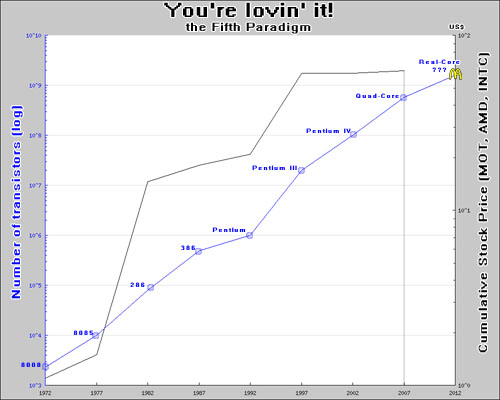
That's quite amazing right?
In 2012, with one single personal computer, a private individual will own the equivalent processing power of 2000's medium scale movie industry render-farm. With the sum of both Central Processing Unit and Graphic Processing Unit, he will roughly put 128 Pentium III on the back burner.
What does that mean? Will everybody run SFX businesses?
Most likely, they won't. It's more probable that major box office winners like Pixar, DreamWorks and ILM will still exist. They will just change their products to fit with this brand new multimedia landscape teeming with powerful computers. They might merge with video game gladiators like Blizzard and use this spare processing power for security reason. Square Enix is already a striking example of this kind of merging.

I know that the present is always invisible because it is environmental and it saturates our whole field of attention. But let's switch to another lingo and let's try to understand and feel like an average witness of this epoch. How drastically this will generate far-reaching environmental changes?
The new personal computers will lead to the enhancement and externalization of his entire central nervous systems; his technological body will evolve to a constantly evolving fantasy where he can virtually do anything his imagination wants; as long as he isn't violating security rules set by the corporate world he will be able to evolve in an infinite extension and intensification of his eye, thus transforming all aspects of his social and psychic existence.
At that time I guess the M@†®X theory will have nothing scary anymore. He won't have the will or the power to change this reality. After blurring the difference in-between movies and video games, the entertainment industry merge will also give him a hard time distinguishing online and real-life experiences. "Real-life" will be associated with a linear perception of predefined events; movies and fictions of the 20th century will be the blueprints. But the real real-life will be the simulation, an open space, like the grotesque pretence of an infinity of Woody Allen scenarios.
This will be the ultimate end of the Renaissance Man, the dusk of the mechanical age of hardware.
This transformation will generate great trauma and identity loss. People will try to understand what to do with it. And they will suffocate in a narcissistic hallucination that will lead them to the zombie trance of the virtual counsumariat. Only people who understand what this new electronic environment is going to do to us will be able to escape slavery.
Does it sound useless to you?
This fascinating prophecy has been thoroughly self-fulfilled by Moore who is the co-founder of Intel. Another interesting law is Rock's Law. It says that the cost of a semiconductor chip fabrication plant doubles every four years. As of 2003, the price had already reached about 3 billion US dollars. Both laws are compatible with each other as long as the ultimate limit to growth of the industry isn't reached. This limit represents the maximum amount of capital that can be invested in new products. As long as we still love processing, at some point, Rock's Law will collide with Moore's Law. But nobody knows when is this collision going to happen?
Let's refresh our bulbo-memories by having a look at the evolution of the semiconductor industry:
That's quite amazing right?
In 2012, with one single personal computer, a private individual will own the equivalent processing power of 2000's medium scale movie industry render-farm. With the sum of both Central Processing Unit and Graphic Processing Unit, he will roughly put 128 Pentium III on the back burner.
What does that mean? Will everybody run SFX businesses?
Most likely, they won't. It's more probable that major box office winners like Pixar, DreamWorks and ILM will still exist. They will just change their products to fit with this brand new multimedia landscape teeming with powerful computers. They might merge with video game gladiators like Blizzard and use this spare processing power for security reason. Square Enix is already a striking example of this kind of merging.
I know that the present is always invisible because it is environmental and it saturates our whole field of attention. But let's switch to another lingo and let's try to understand and feel like an average witness of this epoch. How drastically this will generate far-reaching environmental changes?
The new personal computers will lead to the enhancement and externalization of his entire central nervous systems; his technological body will evolve to a constantly evolving fantasy where he can virtually do anything his imagination wants; as long as he isn't violating security rules set by the corporate world he will be able to evolve in an infinite extension and intensification of his eye, thus transforming all aspects of his social and psychic existence.
At that time I guess the M@†®X theory will have nothing scary anymore. He won't have the will or the power to change this reality. After blurring the difference in-between movies and video games, the entertainment industry merge will also give him a hard time distinguishing online and real-life experiences. "Real-life" will be associated with a linear perception of predefined events; movies and fictions of the 20th century will be the blueprints. But the real real-life will be the simulation, an open space, like the grotesque pretence of an infinity of Woody Allen scenarios.
This will be the ultimate end of the Renaissance Man, the dusk of the mechanical age of hardware.
This transformation will generate great trauma and identity loss. People will try to understand what to do with it. And they will suffocate in a narcissistic hallucination that will lead them to the zombie trance of the virtual counsumariat. Only people who understand what this new electronic environment is going to do to us will be able to escape slavery.
Does it sound useless to you?


![[WATCH OBEY map]](watch-obey.gif)
![[Seize the best out of it since 2006! Smash your TV ★NOW!!★]](videoogle.gif)
![[Valid RSS]](valid-rss.png "Validate my RSS feed")
